
Last updated September 23, 2026
The Complete Guide to Insulation in Burbank
California’s Title 24 sets a minimum R-38 for Burbank attics, but the code floor is not the performance ceiling. We’ve tested homes in the same ZIP code with identical insulation depth that differ by 30% in cooling load because one was air-sealed first and the other wasn’t. Burbank sits in CEC Climate Zone 9, a classification that most insulation guides gloss over or get wrong entirely. The Santa Ana winds, 100°F+ attic temperatures in July, and cool desert nights create a thermal stress pattern that Zone 6 coastal advice or Zone 10 high-desert guidance simply doesn’t address. This guide maps R-value requirements, air-sealing order-of-operations, and material choices to Burbank’s actual climate so you stop buying solutions designed for somewhere else.
Quick Answer
Proper insulation in Burbank means achieving R-38 to R-49 in the attic with materials selected for CEC Zone 9’s hot, dry conditions, but performance depends on air sealing completed first. A typical Burbank home tests at 15-25 ACH50 before proper air sealing and drops to 5-10 ACH50 after, which changes cooling load more than adding insulation alone. The complete job includes a written price before work starts, installed R-value documentation, and pre- and post-blower-door readings you can verify yourself - the same documentation we outline in our How to Hire a Insulation Contractor in Burbank: A Step-by-Step Guide.
Table of Contents
- Why Burbank’s CEC Climate Zone 9 Changes Everything
- R-Value Requirements for Burbank Homes
- Air Sealing First: The Attic Bypass Problem
- Insulation Materials Compared for Burbank Conditions
- The Blower-Door Number That Proves the Result
- What Documentation You Should Hold at Job Completion
- Common Mistakes to Avoid
- When to Call a Professional
- Frequently Asked Questions
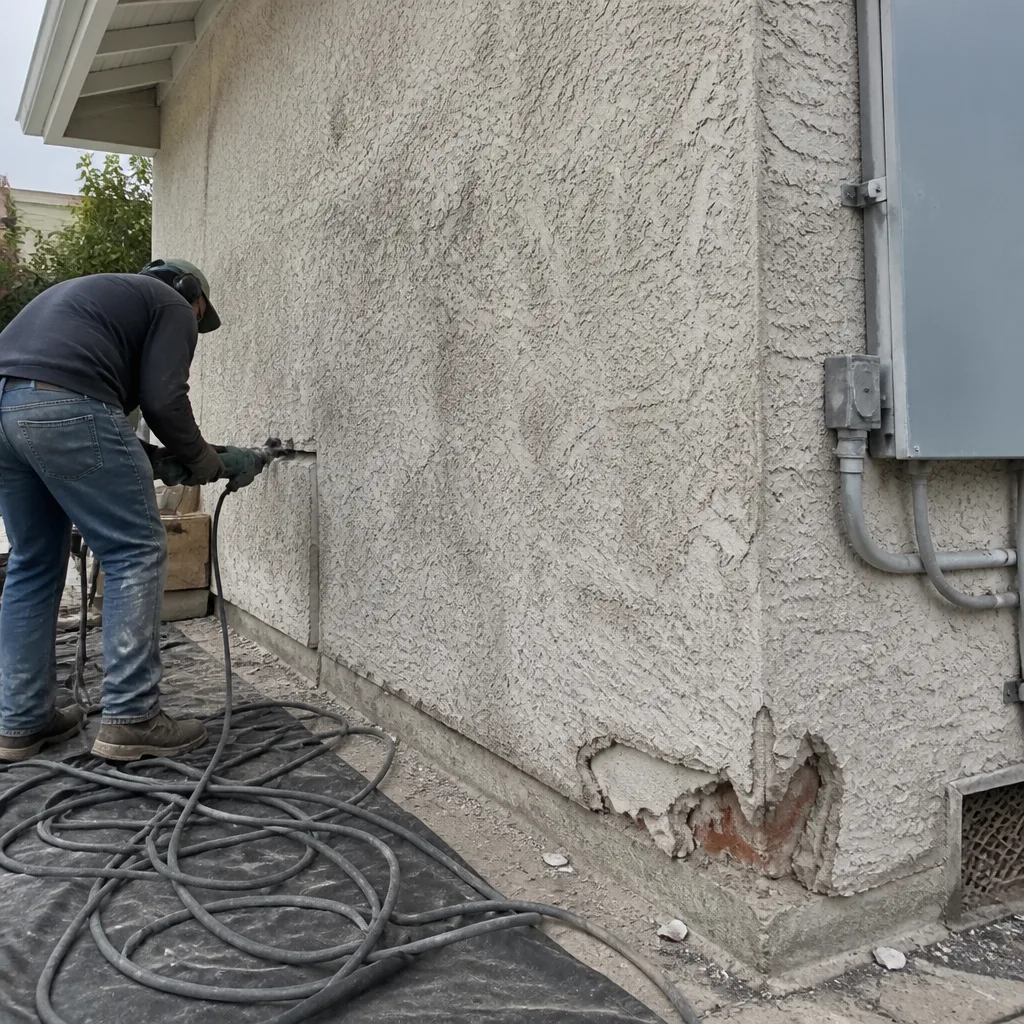 Before
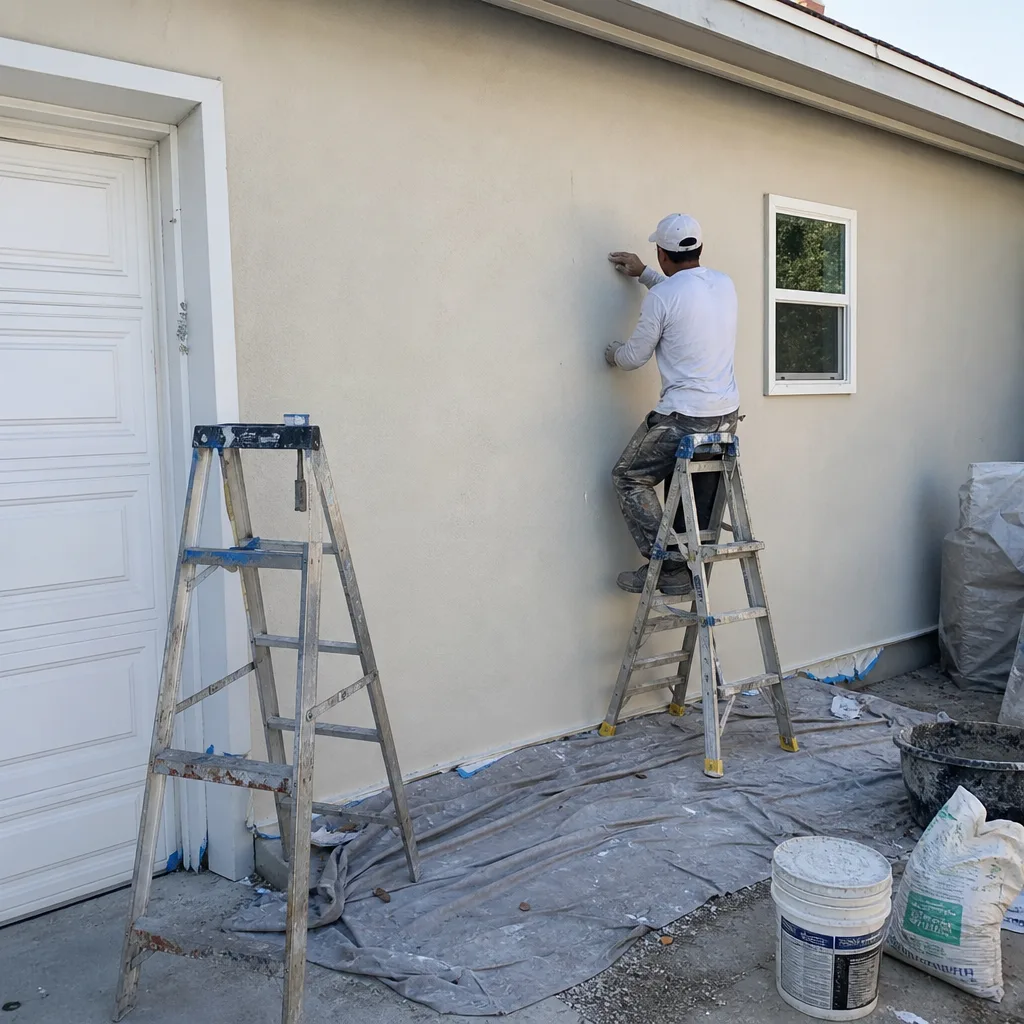 After
AfterWhy Burbank’s CEC Climate Zone 9 Changes Everything
The California Energy Commission divides the state into 16 climate zones. Burbank falls in Zone 9, defined by hot, dry summers with mean daily temperatures exceeding 75°F for four months, cool winter nights that can drop below 45°F, and low annual humidity. This matters because heat moves differently here than in Zone 6 (coastal Los Angeles, moderated by marine layer) or Zone 10 (Palmdale, Lancaster, where temperature swings are more extreme and heating degree-days accumulate faster).
In Zone 9, cooling load dominates. A Burbank attic can reach 140°F in August. Radiant heat gain through the roof deck, not conductive loss through the ceiling, becomes the primary driver of discomfort. This flips the priority list from what works in Sacramento (Zone 12, heating-dominant) or even Santa Monica (Zone 6, mild year-round). Contractors who install the same R-value and material type across all Southern California counties are calibrating to an average that doesn’t exist.
The Santa Ana wind events, typically October through March, add another variable. These hot, dry winds pressurize building envelopes and force air through gaps that remain dormant in calm conditions. A home that performs adequately in July can leak dramatically during a Santa Ana event if top plates, electrical penetrations, and the attic bypass remain unsealed. We’ve measured blower-door readings spike by 15-20% during wind events in homes that tested “acceptable” in still air.
Zone 9 also affects moisture risk. Burbank’s low humidity means vapor drive is primarily outward in winter (warm, moist interior air escaping) rather than inward (humid exterior air condensing on cool surfaces). This changes vapor retarder strategy. In Zone 6, interior vapor retarders are often necessary. In Burbank, they can trap moisture in wall cavities during rare humid periods. The correct approach is an air barrier that stops vapor-carrying air movement, not a vapor barrier that blocks diffusion.
Title 24, Part 6 recognizes these distinctions. Burbank’s prescriptive R-value table requires R-38 minimum for attics in new construction and R-30 for re-roof or alteration projects where full access is limited. But these are minimums. Performance path modeling, which we use for home energy audits, often shows that R-49 with proper air sealing delivers faster payback in Zone 9 than R-38 alone because of the cooling-load dominance.
R-Value Requirements for Burbank Homes
R-value measures thermal resistance. Higher numbers mean slower heat transfer. But R-value is tested under laboratory conditions, 75°F mean temperature, with no air movement. Your Burbank attic operates at none of these conditions. Understanding the gap between labeled R-value and installed performance is the difference between a comfortable home and a persistent complaint.
Title 24 Minimums for Burbank (Zone 9):
- Attic, new construction: R-38 minimum, R-49 recommended for performance path
- Attic, retrofit with full access: R-38
- Attic, retrofit with limited access (top-up over existing): R-30
- Walls, new construction: R-19 or R-13 + continuous insulation
- Floor over unconditioned space: R-19
- Crawl space walls: R-11 to R-19 depending on ventilation strategy
These are code floors. In practice, most Burbank homes built before 1980 have R-11 or less in the attic, often compressed, disturbed, or compromised by prior work. Homes built 1980-2005 typically have R-19 to R-30. Neither is sufficient for Zone 9 cooling loads with current electricity rates.
The performance path allows trade-offs. A home with excellent air sealing (5 ACH50 or below) can meet code with R-38 where a leaky home (15 ACH50) would need R-49 or higher to achieve equivalent energy use. This is why we never quote insulation depth without testing. The blower-door number changes the specification.
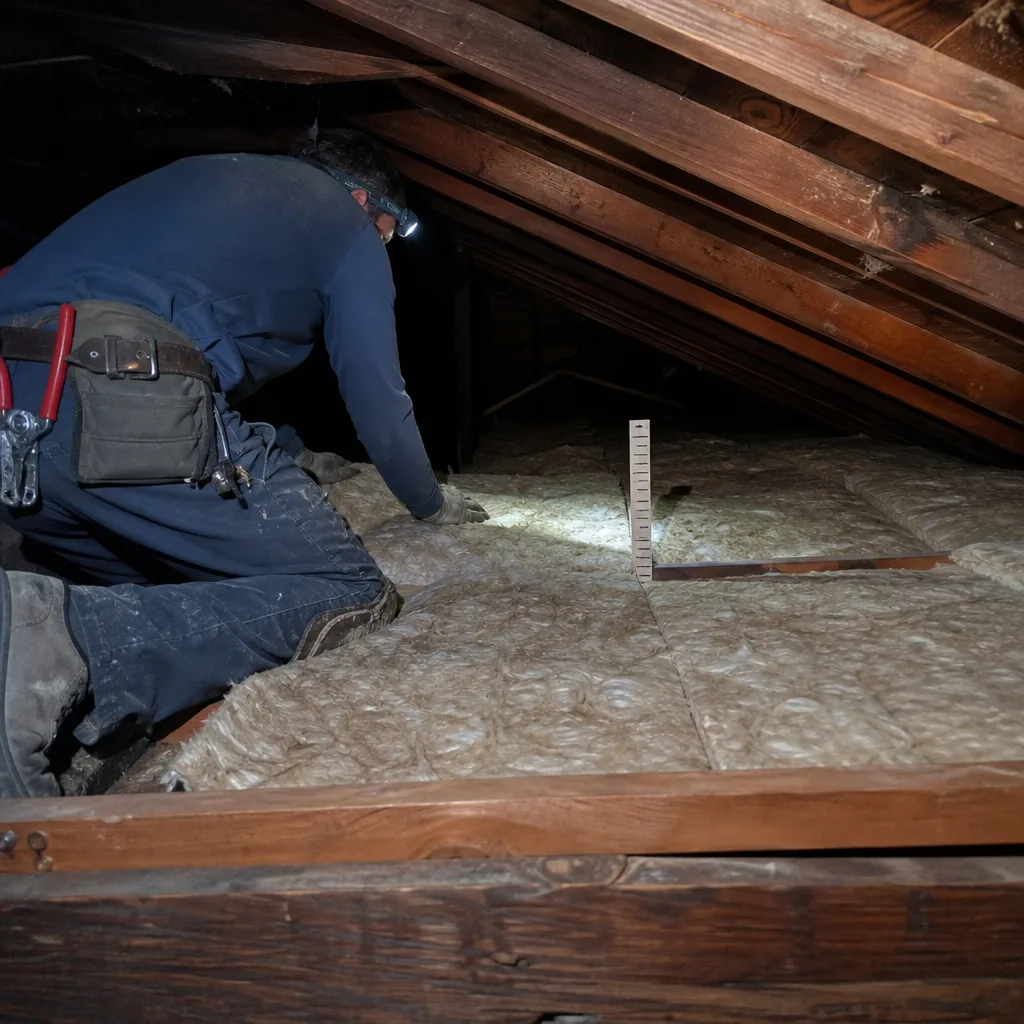
Settled R-value matters more than labeled R-value. Blown fiberglass settles 0-2% over time. Blown cellulose settles 10-20% depending on density and installation technique. Open-cell spray foam doesn’t settle but can shrink 1-3% during curing if temperature or humidity conditions are wrong. We specify installed thickness, not bag count, and verify with depth markers every 300 square feet per Title 24 requirements.
In Burbank’s 140°F attics, high-temperature R-value degradation becomes relevant. Fiberglass loses minimal performance up to 180°F. Cellulose performs well to 150°F but can experience slight degradation above that. Open-cell spray foam is stable to 180°F but can soften if the blowing agent wasn’t fully reacted during installation. Closed-cell spray foam handles 200°F+ but is rarely needed in residential attics and creates moisture management challenges if the roof deck needs to be inspected.
Air Sealing First: The Attic Bypass Problem
We will never blow insulation over an unsealed attic floor. This is not an upsell. It is the sequence that produces a result you can document. Insulation does not stop air movement. It slows conductive heat transfer through solid materials. If air can move through or around it, the R-value is largely irrelevant.
The attic bypass is the single highest-impact leak location in Burbank’s pre-1980 housing stock. This is the gap where interior partition walls meet the attic floor. In platform-framed homes, the top plate of the wall below sits on the ceiling drywall, but the drywall is cut for electrical, plumbing, and duct penetrations. The wall cavity below is open to the attic above. Warm air rises through the wall, carrying moisture and conditioned air directly into the attic. In winter, this drives ice dam risk (minimal in Burbank but present during rare freezes). In summer, it pressurizes the attic and forces conditioned air out through ridge vents and soffits.
How to confirm the attic bypass exists in your Burbank home:
- Enter the attic during daylight with the attic lights off. Look for light streaming through gaps at wall top plates, around chimney chases, and near duct boots.
- Check for dirty insulation. Fiberglass that appears gray or dark at the edges of walls or around penetrations has been filtering air for years. The dirt is the tell.
- Feel for temperature variation on a hot day. The attic bypass acts as a chimney, drawing hot air up in summer. Areas near interior walls will be noticeably warmer than the center of the attic.
- Inspect can lights. Pre-2010 recessed fixtures are rarely IC-rated (insulation contact) and create large penetrations. Even IC-rated fixtures leak unless specifically air-sealed.
- Look for dropped soffits over kitchen cabinets or bath vanities. These are framed chases that connect conditioned space to attic and are rarely sealed at the top.
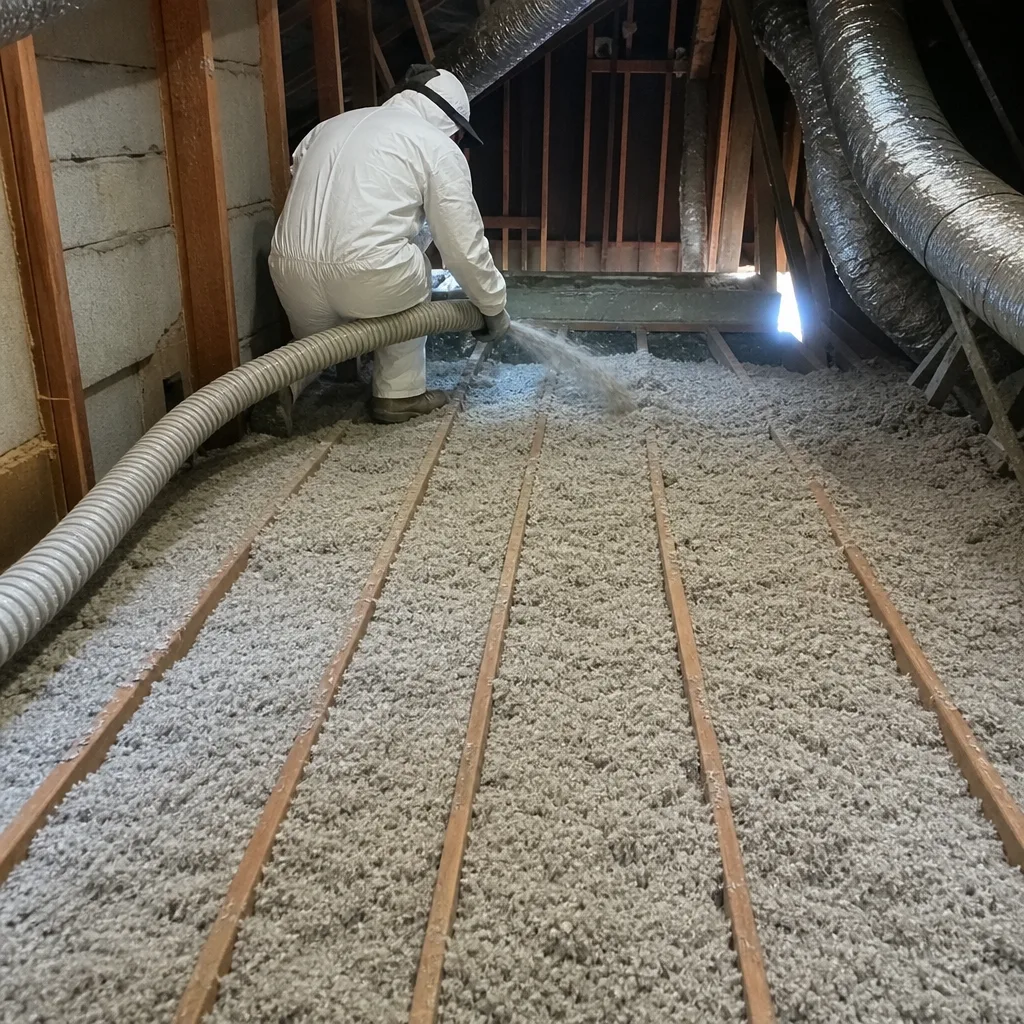
Our protocol, on every attic insulation in Burbank job, is to seal all top plates with fire-rated caulk or foam, box can lights with fire-rated covers, seal duct boots with mastic and mesh, and address chimney chases with metal flashing and high-temp sealant. Only after this is complete do we install insulation. The blower-door test confirms the result.
The order of operations matters for material selection too. Open-cell spray foam, often marketed as “insulation and air sealing in one,” does seal when applied directly to roof decks or wall cavities - but as we detail in our DIY vs Professional Insulation: The Burbank Homeowner’s Decision Guide, attic floor applications are different. But in an attic floor application over existing conditions, it cannot bridge the gap between loose, irregular framing and create a continuous air barrier. We use targeted air sealing first, then blown insulation for cost-effectiveness, or spray foam only when the application is appropriate to the assembly.
Insulation Materials Compared for Burbank Conditions
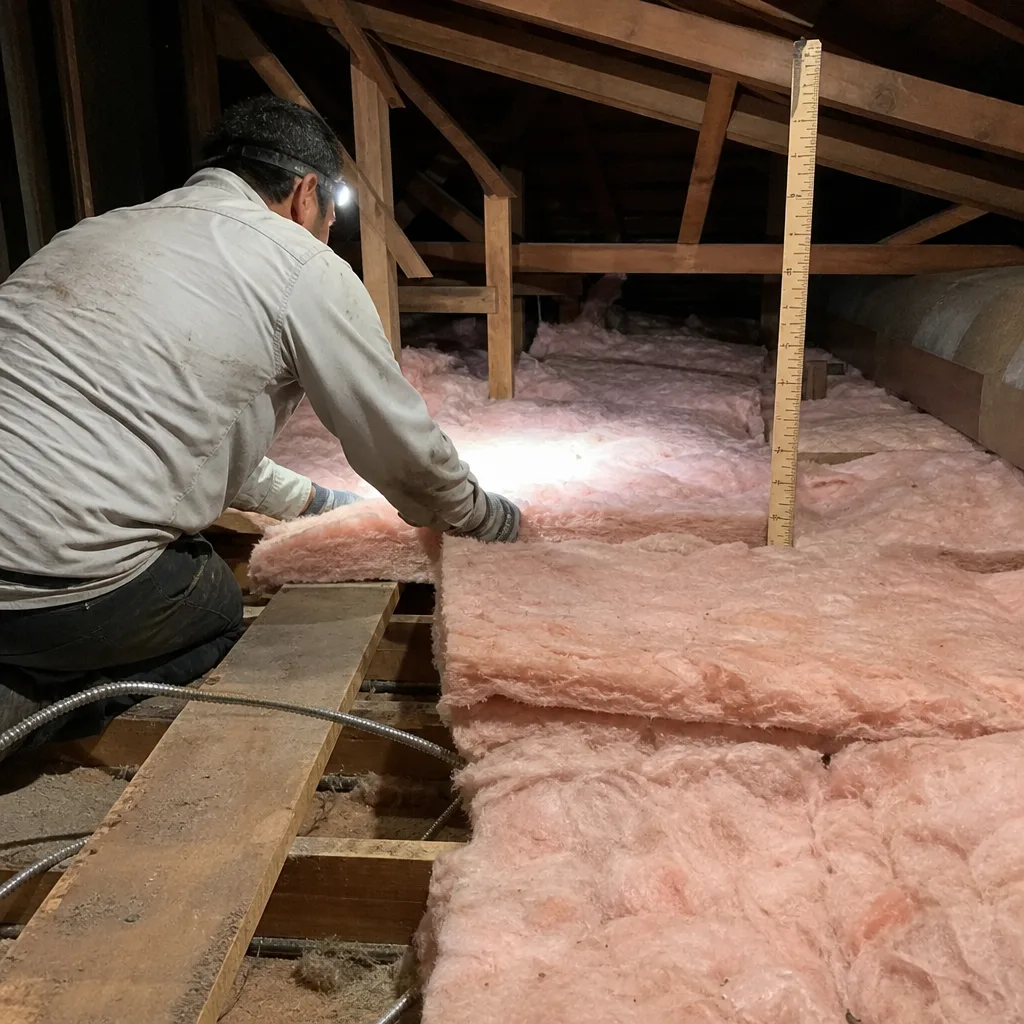
Manufacturers publish R-value per inch at 75°F mean temperature. We use settled R-value at 140°F attic temperature because that’s what your insulation actually does. Here’s how common materials perform in Burbank’s conditions.
| Material | Settled R-value/inch | Temp stability to 140°F | Air sealing contribution | Best application in Burbank |
|---|---|---|---|---|
| Blown fiberglass (loose-fill) | R-2.2-2.5 | Excellent | None without separate air sealing | Attic floor retrofits with existing air sealing or new construction with sealed envelope |
| Blown cellulose (loose-fill) | R-3.2-3.5 | Good | Moderate density reduces convection | Attic floors where higher R-value per inch matters, with proper air sealing first |
| Open-cell spray foam | R-3.5-3.7 | Good | Excellent when applied to continuous substrates | Roof decks (cathedral ceilings), rim joists, irregular cavities where air sealing is integral |
| Closed-cell spray foam | R-6.0-6.5 | Excellent | Excellent | Rim joists, crawl space walls, limited applications where space is severely constrained |
| Fiberglass batts | R-3.0-3.3 | Excellent | None | Wall cavities in new construction with meticulous installation; poor choice for retrofits |
Blown fiberglass, sourced from Owens Corning, Johns Manville, or Knauf, is the most common choice for Burbank attic retrofits. It doesn’t settle significantly, it’s non-combustible, and it performs predictably at temperature. The drawback is density. At standard installation weight, air can still convect through loose-fill fiberglass in a temperature gradient. We address this with proper air sealing below and, in some cases, increasing installed density 15-20% above manufacturer minimum.
Blown cellulose, including GreenFiber products, offers higher R-value per inch and better resistance to convection at standard density because the material packs tighter. The trade-off is moisture sensitivity. Cellulose is treated with borate fire retardant, which also provides mold resistance, but in a roof leak scenario, it compacts and loses R-value faster than fiberglass. In Burbank’s dry climate, this risk is lower than in Zone 6 or Zone 12, but we still inspect roof condition before recommending cellulose.
Spray foam, whether Icynene open-cell or Demilec closed-cell products, is the right choice for specific applications. Open-cell on a roof deck in a Burbank cathedral ceiling creates an unvented, conditioned attic that eliminates the bypass problem entirely. The foam seals the assembly and insulates in one step. But it’s not cost-effective for a standard vented attic floor, and it complicates future roof deck inspection or repair. We specify it when the architecture demands it, not as a default.
Radiant barriers deserve mention for Zone 9. A radiant barrier, typically foil-faced sheathing or draped foil, reduces radiant heat gain from a 140°F roof deck by 95% if installed with proper air gap and emissivity values. In Burbank’s cooling-dominant climate, this can reduce attic temperature 20-30°F, which extends shingle life and reduces duct losses. We install radiant barriers in homes with unconditioned attics and ductwork present, always in conjunction with proper insulation, never as a substitute.
The Blower-Door Number That Proves the Result
ACH50, air changes per hour at 50 pascals of pressure, is the standard metric for envelope tightness. One ACH50 means the volume of air in your home is replaced once per hour under test conditions. The number is meaningless without context, so here’s the context for Burbank.
Burbank home performance benchmarks:
- Pre-1940 bungalow, no prior air sealing: 20-35 ACH50
- 1940-1980 tract home, original condition: 15-25 ACH50
- 1980-2005 home, some weatherstripping: 10-18 ACH50
- 2005-present, code-built: 7-10 ACH50
- After professional air sealing and insulation: 5-8 ACH50
- Passive House standard (reference only): 0.6 ACH50
The 30% cooling load difference we referenced earlier? That shows up between 15 ACH50 and 7 ACH50 with identical R-value. The conditioned air you’re paying to cool isn’t lost through the insulation. It’s lost through gaps the insulation doesn’t cover.
Our protocol on every applicable job: test before, seal, insulate, test after. The homeowner receives both numbers in writing. A typical Burbank retrofit moves from 18 ACH50 to 6 ACH50. The blower-door test itself takes 15 minutes. A fan mounts in an exterior door, depressurizes the house to 50 pascals, and measures airflow through the fan. We use a Retrotec or Minneapolis Blower Door, calibrated annually.
The test also locates leaks. With the house depressurized, we use theatrical fog or a smoke pencil to find active air paths. This is how we identify attic bypasses that visual inspection missed, duct leaks that pressurize cavities, and fireplace dampers that don’t seal. The diagnostic value equals the verification value.
Some contractors skip the test because “you can feel the difference.” We don’t. Under Haven Standard, every job that includes air sealing gets documented before-and-after blower-door numbers. The homeowner keeps the report. If we can’t measure improvement, we haven’t finished.
What Documentation You Should Hold at Job Completion
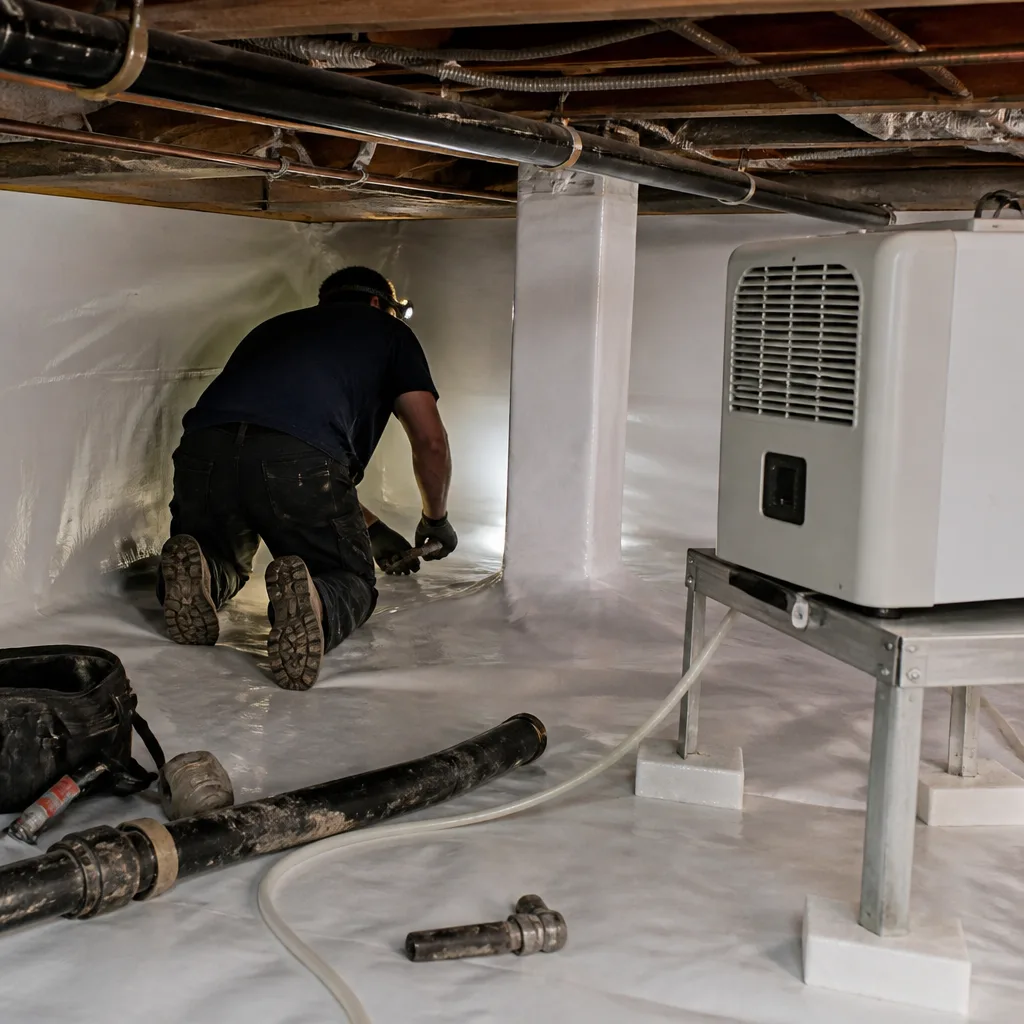
You should know what leaving looks like before we arrive. At job completion for any Topside Attic Insulation Burbank home project, the documentation package includes:
- Written scope of work, signed before start and after completion, listing every assembly addressed, every material specified by manufacturer and product name, and every R-value achieved by location.
- Installed R-value certificate, required by Title 24 for permit jobs and provided voluntarily on all others, showing depth measurements, coverage area, and total installed R-value by assembly.
- Pre- and post-blower-door readings on air-sealing jobs, with the test date, equipment serial number, and technician signature.
- Documented Photo Record, included on every visit, showing before condition, air sealing in progress, insulation installation, and completed assembly. These are delivered digitally, not held until requested.
- Title 24 compliance forms CF1R or CF2R as applicable. CF1R is the pre-installation energy compliance report generated by approved software. CF2R is the installation certificate signed by the contractor and HERS rater confirming the as-built condition matches the compliance report. Not all retrofits trigger HERS verification, but when they do, these forms are mandatory for final inspection.
- Written warranty under the 365-Day Done Right Promise, specifying coverage period, exclusions, and claim process.
Hold these documents. They protect resale value, permit future work without re-testing, and provide baseline data if performance issues arise later. We’ve had Burbank homeowners use five-year-old blower-door reports to diagnose new leaks caused by subsequent remodeling.
Common Mistakes to Avoid
- Adding insulation over unsealed attic bypasses. The new insulation filters air for a few years, then compresses and performs worse than the original. The bypass remains the dominant leak.
- Specifying R-value for coastal Zone 6. A contractor quoting R-30 as “plenty for Los Angeles” is using the wrong zone table. Burbank needs R-38 minimum, R-49 for performance.
- Installing recessed can lights without air-sealing covers. Even IC-rated fixtures leak. In Burbank’s hot attics, this creates a direct path for 140°F air to enter conditioned space.
- Using kraft-faced batts in attic floors. The kraft paper vapor retarder is wrong for Zone 9’s outward winter vapor drive, and batts are nearly impossible to install without gaps in irregular framing.
- Ignoring ductwork in unconditioned attics. Burbank homes with original flex duct in vented attics lose 20-40% of cooling capacity to conduction and leakage before air reaches the register. Insulating the attic floor without addressing ducts solves half the problem.
- Skipping the blower-door test. Without measurement, “tighter” is a guess. With measurement, you have a baseline for future comparison and proof of performance at sale.
- Choosing spray foam for cost reasons in standard vented attics. Open-cell on a roof deck is correct for cathedral ceilings. Open-cell on an attic floor is expensive, difficult to inspect, and rarely the optimal solution for Burbank’s housing stock.
When to Call a Professional
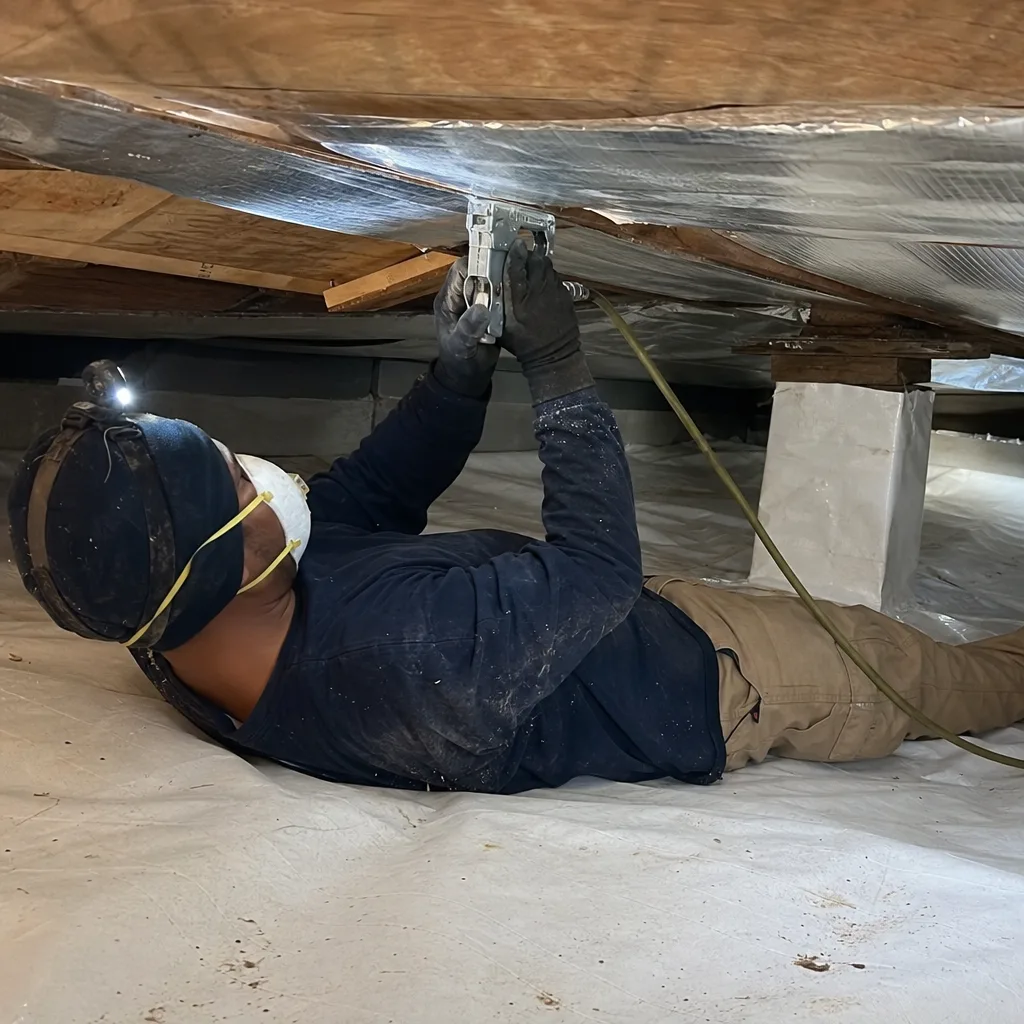
Call when you can’t verify the condition yourself safely or accurately. Attic entry in Burbank’s summer heat is hazardous without hydration and exit planning. Electrical hazards from knob-and-tube wiring, common in pre-1950 Burbank bungalows, require identification before insulation contact. Rodent contamination, also common in older neighborhoods near the Verdugo Mountains, needs remediation before new insulation goes in.
Specific scenarios: your cooling bills exceed $300/month in summer despite a recent HVAC replacement; rooms on the second floor stay 8°F warmer than the thermostat setting; you’ve had ice on the roof edge during rare freezes; or you’re selling and the buyer’s inspector flagged insufficient attic insulation. Crawl space encapsulation and spray foam insulation are specialized applications we assess on site.
Topside Attic Insulation Burbank offers free estimates in Burbank. A technician will inspect your attic, run a blower-door test if air sealing is indicated, and deliver a written price before any work starts. Call (213) 816-1699 to schedule.
Frequently Asked Questions
Most attic insulation jobs in a typical 1,500-2,500 square foot Burbank home run between $2,800 and $5,500 for blown fiberglass to R-38 with proper air sealing, or $4,500 to $8,500 for open-cell spray foam on a roof deck - see our Insulation Cost Breakdown: The Burbank Homeowner’s Reference for 2026 for full pricing variables. The range depends on access difficulty, existing insulation removal needs, and the extent of air sealing required. We deliver a flat written price after inspection, not an estimate range that shifts later. Call (213) 816-1699 for an exact quote - estimates are free.
Title 24 requires R-38 minimum for Burbank attics in new construction and R-30 for retrofits with limited access. We recommend R-49 for performance path compliance in Zone 9’s cooling-dominant climate, especially if the home tests above 10 ACH50 on the blower door. The code floor is not the performance ceiling.
In Burbank’s dry climate, insulation rarely degrades chemically, but it commonly degrades physically from disturbance, compression, or contamination. Top-up over existing insulation costs 40-60% less than full removal and replacement, but only makes sense if the existing material is dry, uncompressed, and free of rodent debris. We inspect and photograph before recommending. If removal is needed, it adds $1.50-$2.50 per square foot to the job.
We can complete most Burbank attic insulation jobs in one day, including air sealing and blown-fill installation. Spray foam applications require cure time and may need a second visit for trim and cleanup. We schedule based on a written scope, not a time estimate, so you know what “done” looks like before we start. Same-week scheduling is typically available. Call (213) 816-1699 to check current openings.
The most common cause in Burbank is attic bypass leakage, not insufficient R-value. Conditioned air escapes into the attic through gaps at wall top plates, can lights, and duct boots, while replacement air pulls in through the envelope below. The insulation doesn’t stop this air movement. A blower-door test with infrared imaging locates the active leaks. We’ve seen homes with R-30 perform worse than homes with R-19 after proper air sealing.
Yes, if the work involves alteration of the thermal envelope under Burbank Building & Safety requirements. Simple top-up of existing insulation to matching R-value may not trigger permitting, but new insulation in an uninsulated space, air sealing as part of an energy alteration, or any spray foam application requires a permit and HERS verification in most cases. We handle permit submission and HERS scheduling as part of our scope. The homeowner receives the approved inspection record and CF2R form at completion.
The Bottom Line
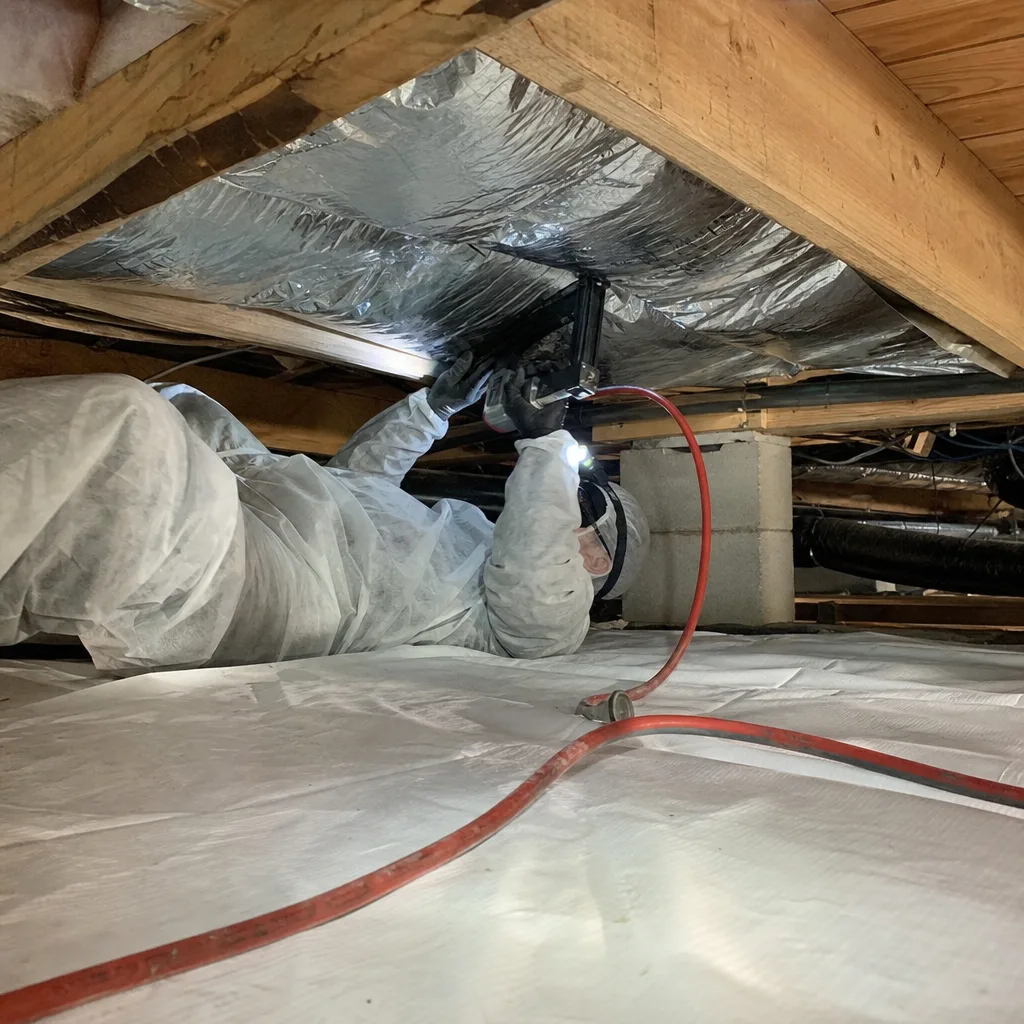
Burbank’s CEC Zone 9 climate demands insulation specified for hot, dry conditions with air sealing completed first. R-38 is the code minimum; R-49 with verified envelope tightness below 8 ACH50 is the performance target that changes cooling bills. Material choice matters less than installation quality and documentation. Every job should leave you with written proof: blower-door numbers, installed R-value certification, and a photo record. Generic advice written for coastal or desert climates wastes money and leaves comfort on the table. For more guides & resources calibrated to Burbank’s actual conditions, see our blog. Insulation in Burbank works when it’s calibrated to Burbank’s actual conditions.
Written by Wes Okafor, Owner at Topside Attic Insulation Burbank, serving Burbank since 2016.